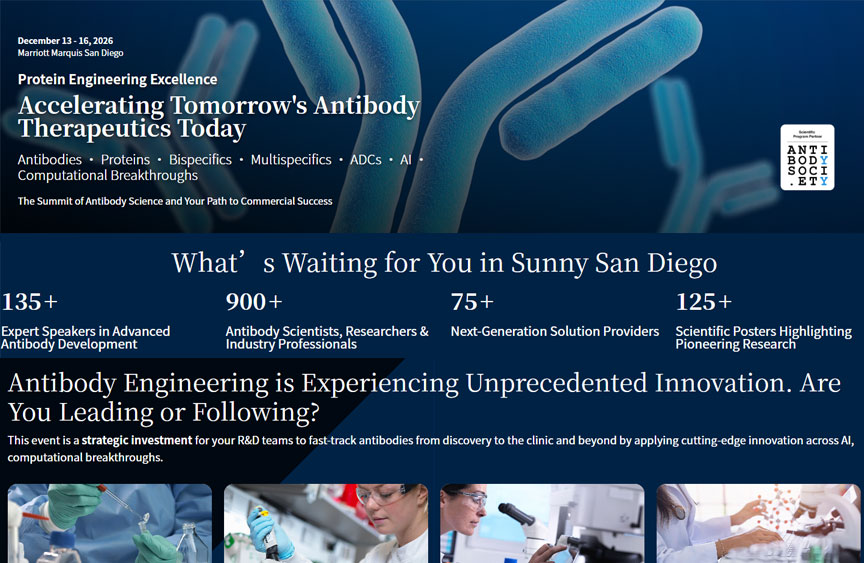

At Antibody Engineering & Therapeutics US 2026 (AET US 2026), the pre-conference workshops and full-day training course take place on December 13. The event runs December 13–16 at the Marriott Marquis San Diego, with the main conference on December 14–16.
The full-day course on December 13 overlaps with both afternoon workshops, which also run at the same time as each other. This guide compares the three options by learning objective, published program, and registration package.
Conference and registration details here were verified as of November 6, 2026. All times are San Diego local, Pacific Time (PT, UTC−08:00). Prices, speakers, and program details are subject to change — check the official site again before you pay and before you travel.
1.0 Three Pre-Conference Options, and Where to Start
All three activities take place on December 13. The learning objectives below are an editorial guide based on the published program, not official proficiency levels. Start with the option closest to the question you want to answer, then check the individual sessions. Here, IND refers to an Investigational New Drug application.
| Option | Learning objective worth checking first | Time (PT) | Scheduling considerations |
| Full-day course: Introduction to Antibody Engineering | Build a structured view of the engineering methods and how they connect | 9:00–17:00 | A biochemistry or molecular biology background helps; overlaps the afternoon workshops |
| Workshop 1: Discovery-to-IND | Understand the connections between molecular design, evaluation, and development decisions | 13:00–17:00 | Runs at the same time as Workshop 2; identify the development question you want to focus on |
| Workshop 2: Candidate Selection and Developability | Get clear on molecule attributes and the assessment questions that follow from them | 13:00–17:00 | Runs parallel to Workshop 1; decide up front which attributes you care about |
| Skip the pre-conference add-on | No specific new learning objective, or the published content repeats what you already know | — | Weigh against your own time and budget |
Check-in for the full-day course opens at 8:30 and instruction starts at 9:00. Both afternoon workshops run 13:00–17:00 and the official site requires you to pick one. The full-day course also overlaps both workshops, so you cannot cover it all. Whether you can switch sessions later, or catch up on the other activity, is a separate question to confirm.
Course titles, times, and the workshop selection rules: https://informaconnect.com/antibody-engineering-therapeutics/workshops/
2.0 What Each of the Three Courses Is Actually For
2.1 Full-Day Course: Filling In the Antibody Engineering Toolkit
The full-day Introduction to Antibody Engineering is taught by David Bramhill. The published topics include functional assays for assessing properties of interest, engineering design, libraries and display methods, and expression and manufacturing platforms for antibodies and fragments. If you want to see those methods as one connected picture, the breadth alone makes the course worth a look.
Before committing a full day, consider your current knowledge: do you need to learn a specific technique, or understand how the methods connect? If you are already familiar with most of the listed topics and have a specific development question, an afternoon workshop may be a closer fit for your learning objective.
Despite the “Introduction” in the title, the site notes that a biochemistry and molecular biology background helps, and that the content moves from fundamentals into advanced concepts fairly quickly. The published agenda lists topics but not a topic-by-topic timetable, so you cannot tell from it which hour covers what you care about.
2.2 Discovery-to-IND: Connecting Design, Translation, and Development
Workshop 1 is titled in full From Discovery to IND: What Matters Most and How to Get it Right. If you want to understand how molecule design connects to translational assessment, clinical pharmacology, and dose selection, start with these three sessions.
– David Shen will cover the key design decisions for bispecific molecules.
– Nichole Escalante will use conditional costimulation as her entry point to discuss design, translational efficacy models, and safety assessment for next-generation T-cell engagers.
– Saileta Prabhu will cover translational PK/PD (pharmacokinetics/pharmacodynamics) and dose selection from a clinical pharmacology angle.
Choose the session closest to your knowledge gap and prepare a question about the connection you want to explore during the talk. These are the topics the speakers plan to cover, not reported results, and IND in the title does not mean the workshop walks through a full regulatory submission.
2.3 Developability Workshop: Molecule Attributes and How They Are Assessed
Workshop 2 is titled in full Engineering Considerations for Candidate Selection and Developability. Before you choose it, write down which class of attributes you want to understand — and whether what you need is the assessment logic, the assay conditions behind it, or the limits on how far a given result can be read.
– Steven Jacobs will focus on how molecule format shapes developability, and on biophysical characterization during discovery and candidate selection.
– Arvind Sivasubramanian’s talk covers antibody polyspecificity and off-target binding.
– Vibha Jawa plans to discuss pairing computational immunogenicity prediction with human immune assays.
Polyspecificity, off-target binding, and immunogenicity mean three different things. Match each one to its own question instead of collapsing them into a single metric.
If off-target binding is what you care about, for instance, come with a question like: what does the screening approach in this talk actually cover, and which limitations constrain how the results can be interpreted?
Published session descriptions can help you judge topical relevance, but they are not a substitute for reviewing the full data. On their own, they do not establish the clinical safety of a candidate molecule.
2.4 Want Both? How to Trade Off
The two workshops may overlap in content, so they need not be treated as separate stages of R&D. Choose between them based on the learning question you most want to answer and the time available.
On December 13, for example, these two talks run opposite each other:
| Time (PT) | Workshop 1 | Workshop 2 |
| 15:45–16:15 | Saileta Prabhu: translational PK/PD and dose selection | Arvind Sivasubramanian: antibody polyspecificity and off-target binding |
A hypothetical walk-through: take an attendee whose goal for this trip is to sort out how off-target binding gets assessed for candidate molecules, and who already has a basic understanding of how PK/PD informs dose selection. Arvind’s talk sits closer to his primary question; if the rest of Workshop 2 also fits his objective, Workshop 2 becomes the first choice. That choice means giving up the chance to hear Saileta’s talk in full in the same slot.
If the main learning question instead concerned PK/PD and dose selection, Workshop 1 might become the first choice. The example is about scheduling only. It does not say which session is generally more valuable, and it says nothing about which experiments a program should run first. Team members can split up according to their own questions, but each person still needs to confirm their own registration entitlement.
Session topics, speakers, and the December 13 parallel slots: https://informaconnect.com/antibody-engineering-therapeutics/agenda/
3.0 Before You Register: Check the Package and the Terms
3.1 Main Conference and Pre-Conference Packages: Access and Cost
Start with what each ticket includes, then look at price. The site lists the December 14–16 main conference ticket, main conference plus the December 13 full-day course, and main conference plus one afternoon workshop as separate packages.
The table below shows the prices displayed on the official website on November 6, 2026, for the default Industry registration category. All amounts are in US dollars. Price differences are calculated between packages for the same category on the same date; they are not standalone course fees.
| Registration option | Pre-conference access | Displayed price that day (USD) | Price difference vs. main conference pass |
| Main conference ticket | No December 13 full-day course or afternoon workshop | 3,599 | Baseline |
| Main conference + full-day training | December 13 full-day course | 4,599 | +1,000 |
| Main conference + afternoon workshop | One afternoon workshop on December 13 | 4,299 | +700 |
At checkout, select the registration category that applies to you and confirm the price, taxes, and order terms.
The site flags November 20 as a price-change date and notes that registering early secures the current rate; the exact cutoff time and time zone are not stated. If you want to secure the rate currently shown on the registration page, confirm the checkout terms before completing your booking. That date is not the final deadline for all registration or pre-conference activity.
For groups of three or more, the registration page provides a group-rate inquiry form. The displayed individual prices are not group quotes; confirm group rates and eligibility with the organizers.
Registration packages by category, current prices, and group-rate inquiries: https://informaconnect.com/antibody-engineering-therapeutics/purchase/select-package/
Price notices and venue details on the conference home page: https://informaconnect.com/antibody-engineering-therapeutics/
3.2 Early-Career Scientists: Check the Dedicated Ticket First
If you are early in your career, check whether the Early Career Scientist rate applies to you. The published criteria are a master’s or doctoral degree completed within the last 10 years, and age under 35. To attend the Early Career Scientist Session on the morning of December 13, you have to register for the main conference on an Early Career Scientist ticket and be approved by the organizers. If you sit at the edge of the eligibility criteria, or your situation is unusual, confirm with the organizers directly.
That morning session runs 9:00–12:00 on December 13. The site separately lists complimentary access to that afternoon’s pre-conference workshops, which slots in after the morning session; the two afternoon workshops still run in parallel, so confirm which one you may choose and what your registration entitles you to. Complimentary admission to an afternoon workshop does not mean that the main conference or the full-day course is free.
Eligibility for the early-career morning session, main-conference registration requirements, and the afternoon benefit: https://informaconnect.com/antibody-engineering-therapeutics/agenda/
3.3 Switching, Cancellation, and On-Demand Access: Confirm Before You Pay
Before you pay, get three things confirmed against the order page or with the organizers:
– Switching or adding: if you later find that another session fits your objective better, can you change your pre-conference selection, and does it cost anything? A same-organization substitution policy does not mean you can freely change workshops.
– Cancellation terms: Under the organizer’s general event terms, the full fee remains payable if you cancel 56 days or fewer before the event or fail to attend, unless the registration process expressly states otherwise.
Once any person on a single or group registration has accessed pre-conference networking or matchmaking facilities, apps, or platforms, the organizers will no longer accept a cancellation. Check your own situation against the registration process, your order, and the applicable terms.
– Replay scope: the digital experience page states that training courses and workshops are not streamed live but will be made available on demand. It does not spell out which specific pre-conference activities each ticket covers. If replay access affects your decision, confirm the ticket type, the activity name, and the viewing window before you pay — and in particular, do not assume that buying one session gets you a replay of the other.
General terms, to be read alongside the terms on your actual order: https://informaconnect.com/antibody-engineering-therapeutics/terms-and-conditions/
Notes on live streaming and on-demand access on the digital experience page: https://informaconnect.com/antibody-engineering-therapeutics/digital-experience/
4.0 Record Your Choice and What You Still Need to Confirm
Write down your main learning question, the reason for your choice, and what you will miss. Then list the registration details you still need to confirm before paying. You can share this record with the person responsible for team training or keep it for your own planning.
– The main question I want to answer at this meeting: ______.
– My first-choice activity and one published session or course topic that supports my choice: ______.
– What I am giving up for it, or why I decided not to add a course: ______.
– Registration category, package, switching conditions, or on-demand access terms I still need to confirm: ______.
– The one question I am bringing with me: ______.
– Whether the extra time and cost match what I am willing to commit: ______.
Confirm your registration category, package, and terms before paying; check the dates, speakers, and time slots again before you travel.