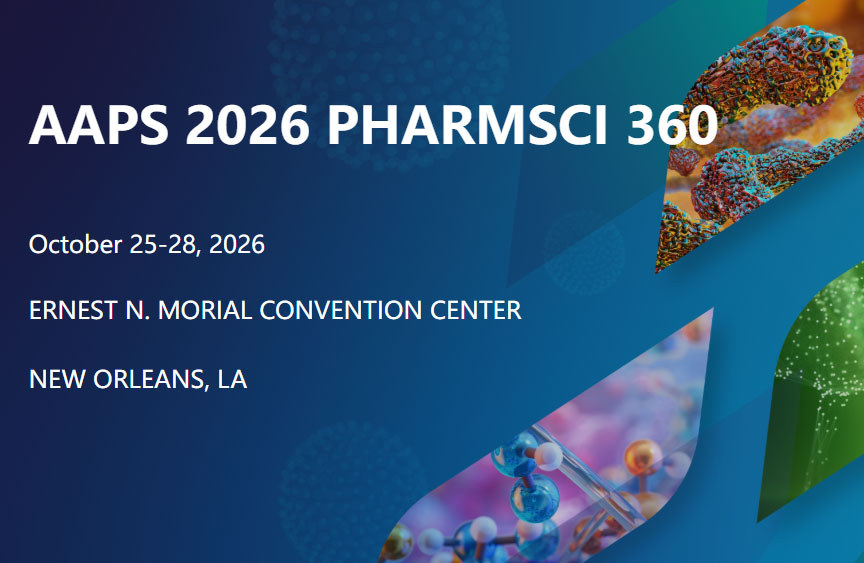
Fact-check date: September 9, 2026. AAPS PharmSci 360 2026 takes place October 25–28 in New Orleans, Louisiana. The meeting organizes the different lines of work in drug development into several scientific tracks, so attendees can go deep within one track or spread their sessions across tracks depending on what the project calls for.
Official source: AAPS 2026 official page: https://www.aaps.org/testingsite/new-page2/pharmsci-360-2026
Before the meeting, write down one sentence: which decision does your project most need to move forward this time? It may involve scale-up and tech transfer, product characterization, formulation and delivery, bioanalysis, or modeling and translational evidence. That sentence is what gives your track and session choices a yardstick.
This guide turns the publicly listed AAPS PharmSci 360 2026 track topics and the current detailed agenda into a pre-meeting decision tool. It helps people in CMC, manufacturing, analytical characterization, formulation and delivery, bioanalysis, and preclinical and translational sciences shape a personal agenda around their project questions. It does not decide technical direction for your team, and it does not promise that any given session will solve a specific project problem.
Sessions, dates, and times in this article are given in U.S. Central Time (CT) and reflect the official EventScribe agenda as accessible on September 9, 2026. As the meeting draws near, go back to the official pages and reconfirm.
1.0 What This Guide Helps You Decide
1.1 Who This Guide Is For
If you are planning what to attend for an active R&D project, this guide works as a pre-meeting screening sheet. It fits situations where the team is sorting through scale-up or tech-transfer risks, rethinking formulation and delivery options, building measurement and data-interpretation strategies for a new modality, or discussing how modeling and translational evidence will shape the next stage of development.
You can jump straight to the section that matches your current work.
– Manufacturing, CMC, analytical characterization, and tech transfer — start with 3.1.
– Formulation, delivery, excipients, stability, and formulation design — start with 3.2.
– Bioanalysis, measurement platforms, comparability, and data interpretation — start with 3.3.
– Preclinical work, modeling and simulation, NAMs, and translational science — start with 3.4.
It is also useful for whoever drafts the team’s first-pass agenda. Agree first on what everyone should bring back after the meeting — a judgment, a list of questions, or material for the next discussion — and then pick sessions. That way the team spends its limited time on the same thing.
| Tasks this guide fits best | Not covered in depth here |
| Screening R&D tracks against current project questions, deciding whether to cross tracks, and building a shortlist of candidate sessions before the meeting | New Orleans city logistics and sightseeing, exhibitor ROI, or job-hunting strategy |
AAPS’s Career Development content has real value in its own right, but it addresses career questions rather than R&D track selection, which is the scope of this article.
1.2 How This Guide Approaches Track Selection
Track selection here works on three levels. Your primary track takes most of your time and maps to the most urgent development decision. Cross-track additions earn their place only when they fill an evidence gap, help two functions align, or surface downstream risk. Individual sessions should always be confirmed against the agenda — abstract, time, and speakers — never chosen on the title alone.
AAPS lets attendees stay within one discipline or move across tracks. Your primary track is therefore a priority line for resolving schedule conflicts: when time runs short, it tells you what to keep — the content most directly tied to your project question.
Official source: official meeting overview: https://www.aaps.org/testingsite/new-page2/pharmsci-360-2026
1.3 The Five Scientific Tracks and What This Guide Does Not Cover in Depth
The 2026 scientific tracks are Preclinical, Clinical & Translational Sciences; Bioanalytics; Manufacturing & Analytical Characterization; Formulation & Delivery; and the Innovator Curated Track. AAPS positions Innovator Curated around cross-disciplinary topics such as research integrity and open science. If your team has concrete questions in those areas, it works well as a supplement; for CMC, formulation, or bioanalysis staff, it is usually not the default primary track.
Official source: official track overview: https://www.aaps.org/testingsite/new-page2/pharmsci-360-2026
Modality types are useful search keywords, but they should not replace a judgment about where the project is actually stuck. LNP, ADC, peptide, oligonucleotide, RNA, and cell and gene therapy programs can all touch formulation, process, characterization, measurement, and translational evidence at the same time.
2.0 Three Judgments to Make Before Browsing the Agenda
The pre-meeting screening sequence boils down to `current project question → primary track → cross-track judgment → candidate sessions`. The next three sections walk through this path one step at a time.
2.1 First, Write Down the Development Decision You Most Need to Advance
The most useful preparation is to write the decision you want to advance as a single sentence. It requires no confidential data, but it must be specific enough to screen the agenda against. For example:
– Before scale-up or tech transfer, which product attribute, characterization, or quality questions do we still need to clarify?
– For the next round of formulation and delivery choices, where is the biggest information gap — materials, stability, prediction, or IVIVC?
– For a new modality, what are we actually missing: measurement methods, comparability assessment, data interpretation, or data handoffs between teams?
– Can our current in vitro data, modeling, or translational evidence support the next internal decision?
“I want to see LNP” or “I want to learn about AI” is not enough to screen an agenda. The same technical term shows up in multiple tracks; only once you have written down the answer you need to take back to the team can you tell main-line content from useful supplements and everything that is merely relevant.
2.2 Set One Primary Track, Then Decide Whether to Cross
Once the primary track is set, three questions tell you whether a cross-track session is worth keeping.
1. Does it fill in a category of evidence the primary question needs — for example, moving from a formulation question to manufacturing feasibility, or from analytical data to translational interpretation?
2. Would it give two functions clearer language for talking about the same risk?
3. Could it change the priority of the next step, rather than just adding one more related fact?
If you cannot answer any of the three, mark the session as a backup. Agendas routinely exceed what one person can absorb; leaving time to digest and to talk to people does more to turn primary-track content into team discussion.
2.3 The Minimum Information to Prepare Before Opening the Agenda
Before opening the agenda, prepare a short pre-meeting card stating where the project stands, what the current risk is, which functions you need to align with, and what output you want after the meeting. The output might be a question to verify, a list of points for internal discussion, or a technical discrepancy that needs further checking.
With that card in hand, every candidate session gets judged by the same standard: does it help me understand the problem, compare options, or confirm a risk — or does it only offer background unrelated to the project? Browsing the agenda becomes faster this way, and it is easier to keep the number of cross-track sessions under control.

3.0 Matching AAPS PharmSci 360 2026 Tracks to R&D Roles and Project Questions
The table below maps common project questions by role to a primary track. It is a starting point for pre-meeting screening; individual sessions, times, speakers, and content still need to be verified line by line in the official agenda.
| Your most pressing question | How to phrase it first | Primary track to start with | When a cross-track session is worth it | Official topic keywords to search | When not to prioritize this |
| Scale-up, tech transfer, manufacturing of complex products, product characterization, process, or quality questions | “Before we move to the next stage, which structural, process, performance-linkage, or control questions need to be clarified first?” | Manufacturing & Analytical Characterization | Formulation & Delivery when formulation design will change manufacturing or product attributes; Bioanalytics when the measurement strategy constrains the judgment | manufacturing, analytical characterization, PAT, scale-up, technology transfer, product performance | When the most pressing issue is formulation or delivery design, and no concrete question yet requires manufacturing, characterization, or quality judgment |
| Formulation, delivery, excipients, stability, IVIVC, or formulation informatics questions | “For the next formulation or delivery decision, which type of materials, prediction, stability, or performance information is the biggest gap?” | Formulation & Delivery | Manufacturing & Analytical Characterization once the risk has shifted to scale-up, characterization, tech transfer, or quality control | formulation, delivery, formulation informatics, excipient screening, stability prediction, IVIVC | When the main risk has already shifted to scale-up, tech transfer, product characterization, or quality control |
| New-modality measurement, method qualification, qPCR/ddPCR, HRMS, biomarkers, immunogenicity, automation | “What evidence do we need before we can trust that the measurement results are good enough to support the next decision?” | Bioanalytics | Preclinical, Clinical & Translational Sciences when data interpretation affects modeling or translational judgment; the manufacturing and characterization track when CMC comparability is involved | HRMS, qPCR, ddPCR, biomarkers, immunogenicity, automation, comparability | When the leading decision already sits with formulation, manufacturing, product attributes, or translational models, and measurement and data interpretation only play a supporting role |
| IVIVE, PBPK, QSP, modeling and simulation, NAMs, organ-on-a-chip, translational biomarkers, MIDD | “Which preclinical-to-clinic decision uncertainty can our existing models or evidence actually reduce?” | Preclinical, Clinical & Translational Sciences | Bioanalytics when the measurement strategy affects model interpretation; Formulation & Delivery when formulation or delivery changes exposure assumptions | IVIVE, PBPK, QSP, translational modeling, NAMs, organ-on-a-chip, MIDD | When more upstream questions — measurement methods, formulation, manufacturing, or product attributes — need to be settled first |
| New-modality programs such as LNP, ADC, peptides, oligonucleotides, RNA, and CGT | “What most needs solving right now — delivery, manufacturing and characterization, measurement, or translation?” | Determined by the current question, not the modality name | Add a second track only when one question genuinely spans two functions, using the criteria above | LNP, ADC, oligonucleotides, RNA, cell and gene therapies, and so on, plus keywords for the primary question | When the only connection is the modality name and the specific project question has not been written down yet |
According to the official topic pages, Manufacturing & Analytical Characterization covers complex products, continuous manufacturing, scale-up, tech transfer, PAT, product performance, and digital manufacturing; Formulation & Delivery includes formulation informatics, excipient screening, high-throughput approaches, stability, and predictive development; Bioanalytics spans new-modality measurement, HRMS, qPCR/ddPCR, automation, and data processing; and the preclinical and translational direction covers IVIVE, PBPK, QSP, NAMs, and translational modeling.
Official source: AAPS 2026 track topics: https://www.aaps.org/aaps/pharmsci/annual-meeting

3.1 Manufacturing, CMC, and Analytical Characterization Teams
Manufacturing & Analytical Characterization is not just for the plant floor. The official topics cover complex products, process and quality systems, product characterization, product performance, continuous and digital manufacturing, scale-up, and tech transfer. CMC and analytical characterization teams can start by narrowing the question to one thing: which structural, process, or characterization information will affect the next round of process, control, or transfer discussions.
Official source: Manufacturing & Analytical Characterization topics: https://www.aaps.org/aaps/pharmsci/annual-meeting
As of the fact-check date, the morning of October 27 features a session on advanced structure and biophysical characterization of LNP systems and biosimilars, plus a session on impurity characterization and lifecycle management; the morning of October 28 lists the symposium “AI-Enabled Predictive Manufacturing and Product Intelligence.” When the project question points to complex-product characterization, impurities and lifecycle management, or digital manufacturing, verify those sessions and their abstracts first.
Official source: Manufacturing & Analytical Characterization detailed agenda: https://aaps2026.eventscribe.net/SearchByBucket.asp?f=TrackName&pfp=manufacturing
Before the meeting, sort candidate content into two buckets. The first serves the primary question directly — complex-product characterization, product performance, PAT, scale-up, or tech transfer. The second is conditional: Formulation & Delivery when formulation design may change product attributes, and Bioanalytics when the analytical or measurement strategy limits comparability and interpretation. The reason for crossing tracks should be an answer to a question you have already written down.
Terms like ADC, LNP, peptides, oligonucleotides, and CGT are fine for searching, but they do not by themselves define the spine of a personal agenda. You still need to judge whether the current risk sits in the process, the product attributes, the measurement, or somewhere else.
3.2 Formulation and Delivery Teams
Formulation & Delivery suits anyone whose focus is formulation, delivery, materials, excipients, stability, predictive development, or product design. Official topics include formulation informatics, AI/ML-assisted formulation design, excipient screening, high-throughput screening, performance and stability prediction, and materials and delivery platforms.
Official source: Formulation & Delivery topics: https://www.aaps.org/aaps/pharmsci/annual-meeting
On the morning of October 26, two Formulation & Delivery symposia run in parallel: “Next-Gen Pharmaceutical Formulation: From Machine Learning to Mechanistic Modeling” and “Rational Design of Small Molecule Formulations: From Modeling to Clinical Translation.” The morning of October 27 includes “Precision Delivery Frontiers: Redefining RNA and Advanced Therapeutics.” The first two overlap in time. If your primary question is how models support formulation decisions, read those abstracts first; if it is RNA or advanced-therapy delivery, make the latter session your priority to verify.
Official source: Formulation & Delivery detailed agenda: https://aaps2026.eventscribe.net/SearchByBucket.asp?f=TrackName&pfp=formulation_delivery
Before the meeting, pin down what you are actually looking for: decision criteria for material selection, early identification of stability risks, prediction of formulation performance, or leads for IVIVC discussions. Each of these points to different session abstracts, case types, and cross-track needs.
When a formulation question turns into one about manufacturing feasibility, tech transfer, product characterization, or quality control, Manufacturing & Analytical Characterization is likely closer to the team’s next risk than more formulation content. And when a manufacturing team’s problem is rooted in formulation and delivery design, put Formulation & Delivery on the supplement list.
3.3 Bioanalysis Teams
Bioanalytics fits questions about how to measure, process, and interpret data reliably. Official topics include method qualification and validation where existing guidance is limited or still evolving, HRMS, qPCR/ddPCR, biomarkers, immunogenicity, automation, new-modality measurement, complex matrices, and data traceability.
Official source: Bioanalytics official topics: https://www.aaps.org/aaps/pharmsci/annual-meeting
On the morning of October 27, the Bioanalytics track runs two parallel symposia: “Measuring the Unmeasurable: Bioanalytical Innovation for Emerging Modalities” and “Oligonucleotide Bioanalysis: Ring Trial and Emerging Conjugate Modalities.” The morning of October 28 features “Biomarker-to-Decision: Biomarker Contexts of Use and Fit-for-Purpose Strategies” and “Innovations in Clinical Sampling and BA Lab AI/Automation.” The first pair is closer to new-modality, oligonucleotide, or platform measurement questions; the second pair suits questions about how biomarkers get used, sampling workflows, and lab digitalization. Decide which category your question falls into first, then check whether the specific session covers the methods or sample scenarios you need.
Official source: Bioanalytics detailed agenda: https://aaps2026.eventscribe.net/SearchByBucket.asp?f=TrackName&pfp=Bioanalytics
Ask yourself before the meeting: is the gap in the measurement itself, in comparability, in data quality, in samples and workflows, or in the link between measurement results and downstream decisions? That distinction reshuffles agenda priorities. When the team’s focus is methods, platforms, or data processing, Bioanalytics should be the primary track; when the core question becomes how results influence modeling, exposure, or translational judgment, add preclinical and translational content; and when it comes down to product attributes or CMC comparability, add the manufacturing and characterization direction.
Do not extrapolate official topic labels into claims that a method is already accepted in any regulatory context. A safer goal for attending is to bring back method questions to verify, comparison dimensions, or items for cross-team communication.
3.4 Preclinical, Clinical, and Translational Sciences Teams
Preclinical, Clinical & Translational Sciences fits anyone prioritizing IVIVE, PBPK, QSP, modeling and simulation, NAMs, organ-on-a-chip, translational biomarkers, or MIDD. Official materials tie these topics to translational decisions from early research through clinical application.
Official source: preclinical and translational topics: https://www.aaps.org/aaps/pharmsci/annual-meeting
The detailed agenda offers filterable session groups. On the morning of October 26, there is “Integrating AI, Biomarkers, and Modeling to Advance Translational Drug Development,” plus “Biodistribution and Persistence as the New Exposure Science for Gene & Cell Therapies: From Vectors to Living Drugs”; the morning of October 27 has “Model-Informed Innovation: Integrating NAMs Across Translational Workflows”; and the morning of October 28 has “Adaptive Dosage Modifications – MIDD Opportunities & Challenges.” These correspond, respectively, to how models and biomarkers support translation, translational evidence for new modalities, how NAMs enter the workflow, and how model-informed development enters decision-making.
Official source: Preclinical, Clinical & Translational detailed agenda: https://aaps2026.eventscribe.net/SearchByBucket.asp?f=TrackName&pfp=translational
When screening sessions, start by asking which specific uncertainty each one would reduce — for example, how in vitro data and models together support a judgment, which assumptions still need experimental evidence, or which data-quality issues would limit model interpretation. That keeps modeling, translation, and clinical development content anchored to work items the team can actually discuss.
When the measurement strategy determines whether data are usable, put Bioanalytics on the supplement list; when formulation, delivery, or product design affects exposure and translational assumptions, look at Formulation & Delivery as well. Official topic descriptions describe the direction of meeting content — they cannot be stretched into judgments about any project’s clinical outcome, regulatory outcome, or probability of success.
3.5 How New-Modality and Cross-Functional Teams Pin Down the Primary Question
New-modality programs usually demand cross-functional collaboration. Have the team answer one question together first: does the current decision lack delivery and formulation, manufacturing and characterization, measurement and comparability, or modeling and translational evidence? The answer sets the primary track, and everything else enters the backup list according to actual gaps.
Take LNP as an example. When comparing materials, formulations, or delivery performance, verify the precision delivery of RNA and advanced therapies content first; when discussing product attributes, scale-up, quality, or transfer, start with LNP structural characterization; when the bottleneck is measurement and data interpretation, start with Bioanalytics. This illustrates a screening method — it is not R&D advice.
The Innovator Curated Track can be added when the team has concrete questions around research integrity or open science — there is no need to force it in just to cover every track.
4.0 Turning Your Track Choice into a Personal Agenda
4.1 Screening Sessions with the Primary Question and Topic Keywords
Four steps take you from track choice to candidate sessions.
1. Keep the one-sentence primary question from Section 2.1 next to the official agenda search box.
2. Pick two to four topic keywords from the table in Section 3.0.
3. Read the abstracts of candidate sessions and check whether they deal with methods, cases, comparisons, regulatory issues, or broader background.
4. Write down one sentence on the expected takeaway for each session you keep.
As of the fact-check date, the table below maps project questions to verifiable groups of official sessions. It is not a recommendation list or a complete schedule. Before committing to any schedule, confirm each row against the official full agenda.
Official source: official full agenda: https://aaps2026.eventscribe.net/agenda.asp?all=1
| If your primary question is | Official session groups to verify first (all times U.S. Central) | Question to ask yourself | Cross-track you may need |
| Structure and characterization of LNP, complex products, or biosimilars | October 27, 09:00–11:00 — Manufacturing & Analytical Characterization session on advanced structure and biophysical characterization of LNP systems and biosimilars | Is my gap in product attributes, characterization methods, or the link between this information and process or performance? | Formulation & Delivery or Bioanalytics |
| Impurities, lifecycle management, or analytical strategy | October 27, 09:00–11:00 — Manufacturing & Analytical Characterization session on modern analytical strategies for impurity characterization and lifecycle management | What most needs clarifying this time — detection, characterization, control, or lifecycle decisions? | Bioanalytics |
| Formulation modeling, mechanistic modeling, or small-molecule formulation design | October 26, 09:00–11:00 — Formulation & Delivery’s “Next-Gen Pharmaceutical Formulation: From Machine Learning to Mechanistic Modeling,” alongside “Rational Design of Small Molecule Formulations: From Modeling to Clinical Translation” | Of the two parallel sessions, which is closer to my actual development stage and desired output? | Preclinical, Clinical & Translational Sciences |
| RNA or advanced-therapy delivery | October 27, 09:00–11:00 — Formulation & Delivery’s “Precision Delivery Frontiers: Redefining RNA and Advanced Therapeutics” | Do I care most about delivery design, product attributes, measurement, or translational evidence? | Manufacturing & Analytical Characterization or Bioanalytics |
| Bioanalytical questions for new modalities, oligonucleotides, or method platforms | October 27, 09:00–11:00 — Bioanalytics’ “Measuring the Unmeasurable: Bioanalytical Innovation for Emerging Modalities,” alongside “Oligonucleotide Bioanalysis: Ring Trial and Emerging Conjugate Modalities” | What do I need to solve — measurement platforms, samples, comparability, or result interpretation? | Preclinical, Clinical & Translational Sciences |
| How models, NAMs, or MIDD support translational decisions | October 27, 09:00–11:00 — Preclinical, Clinical & Translational Sciences’ “Model-Informed Innovation: Integrating NAMs Across Translational Workflows”; October 28, 09:00–11:00 — “Adaptive Dosage Modifications – MIDD Opportunities & Challenges” | Which existing assumption or evidence gap would this content reduce? | Bioanalytics or Formulation & Delivery |
Finally, record four things for each session you keep: the session itself, the project question it maps to, the judgment or question you hope to come away with, and who you need to discuss it with. If the last two cannot be filled in, leave the session as a backup rather than letting it eat into primary-track time.
4.2 Setting a Bar for Cross-Track Sessions
Cross-track sessions need a clear reason. To keep the schedule from filling up with look-alike topics, sort candidate sessions into three tiers.
| Priority | Keep-it condition | What to produce afterward |
| Primary track first | Directly answers the current project question, or provides the key evidence leads needed for the next judgment | A judgment, risk, or question to verify that can be taken back to the team |
| Cross-track supplement | Fills an evidence gap, connects two functions, or exposes downstream impact | One concrete cross-functional alignment item |
| Backup or post-meeting reading | Topically relevant, but you cannot say which next-step decision it would influence | Links, abstracts, or a reading list for later — not conflicting time slots |
This is not a judgment of session quality — only a trade-off of time. Team members can split up different primary tracks, but they should share the project question card and the post-meeting output format.
The two parallel modeling sessions listed in Section 3.2 are a case in point. Do not try to attend both just because both are relevant; use the project question to decide whether you need more on mechanistic and machine-learning approaches in formulation development, or on moving small-molecule formulation from modeling to clinical translation. If the latter also touches exposure or translational evidence, then add a preclinical and translational session.

4.3 Re-verifying the Agenda and Your Plan as the Meeting Nears
Sessions, speakers, times, registration, and hotel details can all change. The track topics and session examples in this article come from public sources, so check the meeting page, the current EventScribe agenda, the registration page, and the hotels page both before publishing and before departing. When page information conflicts, give priority to the current edition, the more recently updated source, and whatever matches the official registration or policy pages.
Leave room to adjust the personal agenda too. When session times shift or something closer to the primary question appears, protect the primary track first and consider dropping cross-track backups. As long as the screening criteria stay the same, the plan can flex with the agenda.
5.0 Final Action Checklist Before Registering and Departing
5.1 Confirm Your Registration Type Covers Your Plan Before You Register
Before comparing prices, confirm that the registration type actually covers the meeting plan. The official page currently lists Full Conference, 1-Day Pass, and Exhibits & Networking Pass options; Full Conference includes access to scientific sessions, the Solution Center, and the Welcome and Closing Receptions. When team members carry different track or day assignments, each of them should check the accessible content on the official page separately.
Official source: 2026 official registration information: https://www.aaps.org/pharmsci/register
For four or more full-conference attendees from the same company, the official page currently lists a group discount of $100 per person. Rules like this can involve eligibility and redemption details, so the person actually registering should verify them directly.
5.2 Dates to Watch
As of this article’s fact-check date, the relevant milestones are as follows.
Official source: registration page: https://www.aaps.org/pharmsci/register
Official source: hotels page: https://www.aaps.org/pharmsci/accommodations
| Milestone | What to check |
| August 26 – September 25 | Advance Registration period |
| September 25 | Deadline to redeem the group discount for four or more full-conference attendees from the same company |
| From September 26 | On-Site Registration begins |
| October 1 | Official hotel booking deadline; eShow is the official housing provider |
All of this is dynamic information. The official website does not state the precise cutoff time for every date in the places verified for this article, so as milestones approach, defer to the rules shown on the current official pages.
5.3 Five Final Checks
– Have I written the project problem I want to solve as a single sentence I can search the agenda with?
– Have I committed to one primary track, rather than just collecting hot topics?
– Does every cross-track session have a clear reason — filling an evidence gap, aligning functions, or judging downstream impact?
– Have I verified the specific sessions, times, and abstracts in the official agenda?
– Do my registration type, key dates, travel plan, and post-meeting output plan still line up with the primary question?
Once these five are done, the schedule is built around one R&D question worth taking back to the team — and it will be much easier to adjust as the agenda changes.