PEGS Europe 2026 Agenda: Choose the Right Sessions

Photorealistic AI-generated image for a PEGS Europe 2026 agenda-planning guide. Two conference attendees review a printed program and a tablet in a generic scientific-conference foyer. The people, venue and poster are synthetic and do not document the actual event.
Three talks in the PEGS Europe 2026 agenda start at 8:30 a.m. on November 17: structural modeling, conditionally activated T cell engagers (TCEs), and T cell receptor (TCR) bispecific strategies. If you develop bispecific or multispecific antibodies and you’re already planning to attend, work out which one answers the project question in front of you before you check dates and what your registration actually covers.
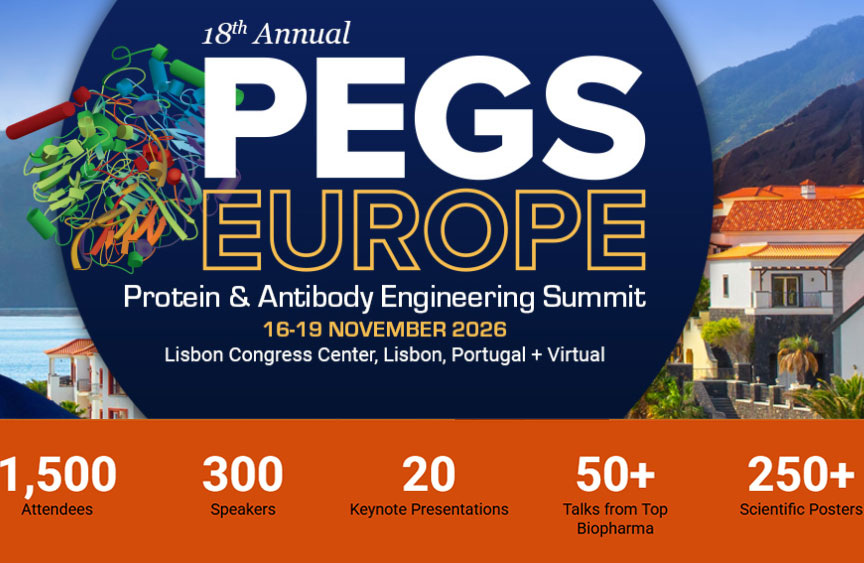
PEGS Europe 2026 runs November 16–19 in Lisbon, Portugal. This article uses three real conflicts in the 8:30 a.m. slot on November 17, 18 and 19 to show how those trade-offs get made, then adds one standalone talk at 2:35 p.m. on the 17th. It is not a curated itinerary for all three days. Facts were checked on October 20, 2026. Times are WET (GMT/UTC), taken from the official program and converted here to 12-hour time. Only published start times are listed.
Conference dates and the official program: https://www.pegsummiteurope.com/
Lisbon Congress Center venue details: https://www.pegsummiteurope.com/travel
1.0 Start With the Project Question, Then Check Dates and Access
1.1 Turn Your Reason for Attending Into a Question That Can Rule Sessions Out
“I want to hear about bispecifics” is too broad to guide a choice between relevant talks. Turn it into a question that helps you rule out sessions you don’t need. For example, if you already have a candidate bispecific and want to understand how mispaired variants are evaluated, aim to identify what is being assessed, what evidence is used, and under what conditions the approach applies. With that question written down, “bispecific” in the title is no longer your only screening criterion.
| Entry question | Track to check first | What to bring back | What you can rule out up front |
| How does the design map onto the functional goal? | Safety & Efficacy; Engineering Bispecifics; T Cell Engagers if TCEs are in scope; Advancing Multispecifics for immunogenicity engineering | Molecular format, the problem it is meant to solve, the design trade-offs, and how far the evidence reaches | Talks that share a keyword but address a different development task |
| What is still open on developability or chemical stability for the candidate? | Optimisation & Developability; Protein Stability & Formulation | What the workflow is intended to assess, the evidence supporting the mechanistic case, and the questions the available evidence leaves unresolved | Conclusions about clinical success or failure based only on early predictions; talks unrelated to the attribute you are investigating |
| How do we evaluate and control mispaired variants? | Analytical Characterisation | What is being assessed, the factors that inform strategy selection, and the impact on product quality | Molecular design talks that share the bispecific label but do not address the analytical question |
Write the project question in three lines so you can check sessions against it later:
– My primary question: __________
– Evidence or information I want to bring back: __________
– Questions I am deliberately not taking on this time: __________
Track names and the full program: https://www.pegsummiteurope.com/programs
1.2 Check Date Combinations, Access Rules and Short Courses
The registration page shows the dates in four columns: A is November 16, B is November 17, C is November 18, and D is November 19. Column A maps to the Training Seminars; B, C and D are the main-conference days this article covers.
– Best Value: A+B+C+D.
– Premium: A+B+C, or B+C+D.
– Standard: A+B, B+C, or C+D.
To cover all three main-conference days sampled here, the package has to include B, C and D. Of the combinations listed, Premium B+C+D and Best Value both qualify.
Registration asks which conference track you expect to attend most, so the organizers can estimate attendance per track. The official guidance lets attendees move between conference presentations within the same time slot, but not between conference sessions and Training Seminars. Before submitting the form, check the meeting year, selected date combination and activity type. If you have already registered, verify these details against your confirmation.
All three short courses on November 16 run 2:00–5:00 p.m., are in-person only and require separate registration; the main conference packages do not include them. The package page also lists Virtual and On-Demand access for one year. The availability and release dates of recordings for the individual talks listed here have not been confirmed, so the package description should not be taken as a guarantee that every missed concurrent talk will be available to watch later.
Registration packages, date combinations and rules for moving between conference sessions: https://register.cambridgeinnovationinstitute.com/reg/pge
Short course times, in-person requirement and separate registration: https://www.pegsummiteurope.com/short-courses
2.0 Three Real Conflicts and How to Pick Between Them
All three groups below start at 8:30 a.m., one on each of the 17th, 18th and 19th. “Look at first” and “Hold” are editorial calls tied to the project question. A public abstract supports what a talk intends to cover; it is not independent verification of results.
2.1 November 17, 8:30 a.m.: Structural Modeling, Conditionally Activated TCEs and TCR Bispecifics
Three sessions start at the same time and cover different ground: structural design of multispecifics, conditionally activated TCEs in solid tumors, and multiplexed targeting with TCR bispecifics. In P08, target coverage concerns multiple peptide–HLA (pHLA) complexes, as described in the public abstract.
| Talk, short title and WET start | Speaker and official track | Look at first | Hold if |
| P01 | Structural modeling of multispecific antibodies | 8:30 a.m. | Saeed Izadi (Gilead Sciences); Optimisation & Developability | You want to see how geometry, flexibility, and conformational sampling feed into multispecific design | You only need mispaired-variant evaluation, not structural design background |
| P02 | Conditionally activated TCEs | 8:30 a.m. | Aude Segaliny (Amberstone Biosciences); T Cell Engagers | You are weighing conditional activation in solid tumors and want the trade-off between selectivity and activity | TCEs are outside your current scope, or conditional activation is not relevant to your project question |
| P08 | Single-chain TCR bispecific approach | 8:30 a.m. | Fabian Richter (Immatics Biotechnologies GmbH); Safety and Efficacy of Bispecific and Multispecific Antibodies | You need to understand antigen heterogeneity in solid tumors and coverage across multiple pHLA targets | TCR/pHLA formats are outside your current scope, or you are not investigating coverage of multiple pHLA targets |
| P03 | Developability workflows and their prediction gaps | 2:35 p.m. | Hristo Svilenov (Technical University of Munich); Optimisation & Developability | You want to compare what early biophysical screening and computational models can actually assess, and where the gaps are | You only need mispaired-variant information, not workflow-level judgment |
Official titles, for finding these again in the program:
– P01: Practical, Scalable Structure-Based Modelling for Rational Engineering of Multispecifics
– P02: KEYNOTE PRESENTATION: Enhancing Safety to Unlock Efficacy: A Novel Class of Conditionally Activated TCEs for Solid Tumours
– P08: Unlocking Target Multiplexing in Solid Cancers with a Novel Single-Chain TCR Bispecific Approach
– P03: KEYNOTE PRESENTATION: Predictive Strengths and Critical Gaps in Next-Generation Developability Workflows
Titles, speakers, times and abstracts for P01 and P03: https://www.pegsummiteurope.com/optimisation-developability
Title, speaker, time and abstract for P02: https://www.pegsummiteurope.com/t-cell-engagers
Title, speaker, time and abstract for P08: https://www.pegsummiteurope.com/bispecific-safety-efficacy
P03 starts at 2:35 p.m. and centers on what developability workflows can and cannot predict, which is a different discussion from the three morning talks. The safety and therapeutic-window claims in P02 are the speaker’s own; this article does not restate them as independently verified clinical findings.
2.2 November 18, 8:30 a.m.: Mispaired Variants and Hypoimmunogenic Engineering
This pair splits between analytical control and precision B cell targeting. If the pressing question is how to evaluate mispaired variants, take P04. If the team’s problem is immunogenicity engineering through B cell targeting, P05 is closer.
| Talk, short title and WET start | Speaker and official track | Look at first | Hold if |
| P04 | Evaluating mispaired variants across bispecific formats | 8:30 a.m. | Maki Yoshida (Chugai Pharmaceutical Co., Ltd.); Analytical Characterisation of Biotherapeutics | You need to know how mispaired-variant evaluation shifts across bispecific formats, factoring in separation mode, throughput, process requirements, pairing efficiency, and quality impact | Variant analysis or control isn’t the main goal this time and you don’t need the background |
| P05 | Precision B cell targeting for low immunogenicity | 8:30 a.m. | Dikran Aivazian (ADAXION Therapeutics); Advancing Multispecific Antibodies and Combination Therapy to the Clinic | You want to understand the proposed use of precision B cell targeting to engineer hypoimmunogenic biotherapeutics, and the scope of the supporting evidence | You need analytical characterization information and are not planning to evaluate this engineering approach |
Official titles, for finding these again in the program:
– P04: Strategy for Evaluating Undesired Mis-Paired Variants across Bispecific Antibody Modalities
– P05: Engineering of Hypoimmunogenic Biotherapeutics through Precision B Cell Targeting
Title, speaker, time and abstract for P04: https://www.pegsummiteurope.com/characterising-biotherapeutics
Title, speaker, time and abstract for P05: https://www.pegsummiteurope.com/advancing-multispecifics
The P05 abstract describes CD22/Siglec-2-related B cell targeting. A pre-meeting abstract cannot establish that the approach broadly reduces anti-drug antibody responses in patients or that immunosuppression risk is absent.
2.3 November 19, 8:30 a.m.: CD2 Costimulation Design and Chemical Stability Mechanisms
Two sessions, one slot. Teams working on TCE costimulation design should start with P06. If you are chasing a specific chemical degradation mechanism, P07 is closer. If neither matches what you are working on, keep scanning the rest of that day’s program. Forcing a choice between two irrelevant talks defeats the purpose.
| Talk, short title and WET start | Speaker and official track | Look at first | Hold if |
| P06 | Trispecific TCE with CD2 costimulation | 8:30 a.m. | Jeremy S. Myers (EvolveImmune Therapeutics Inc.); Engineering the Next Generation of Bispecific Antibodies | You want to see how TCR activation and costimulation come together in TCE design, and what drives costimulatory pathway and target selection | Your work sits in analytical control or chemical degradation, with no TCE costimulation |
| P07 | An unusually stable succinimide intermediate | 8:30 a.m. | Goran Miličić (Novartis); Protein Stability & Formulation | You are tracking down an unusual chemical degradation behavior and want the experimental observations, structural data and molecular dynamics behind it | You only want general quality conclusions, or you have no chemical stability question right now |
Official titles, for finding these again in the program:
– P06: Evolve: A Trispecific T Cell Engager with Integrated CD2 Costimulation for the Treatment of Solid and Hematologic Tumours
– P07: Mechanistic Understanding of an Unusually Stable Succinimide Intermediate in an Antibody Therapeutic
Title, speaker, time and abstract for P06: https://www.pegsummiteurope.com/engineering-bispecifics
Title, speaker, time and abstract for P07: https://www.pegsummiteurope.com/protein-stability
P07’s speaker name was cross-checked against a Novartis profile story; the 2026 slot itself still follows the current program: https://www.novartis.com/si-en/stories/work-changes-patients-lives
P07 discusses an unusually stable succinimide intermediate in an antibody therapeutic, drawing on experimental findings and molecular dynamics simulations based on an X-ray structure to explore the mechanistic basis of that stability. The stability of this intermediate does not establish the overall stability of the antibody therapeutic. The P06 abstract lists design considerations for the planned talk; it does not establish that trispecific TCE designs incorporating CD2 costimulation outperform other designs.
3.0 A Worked Example: Write the Reasoning Into the Schedule
3.1 Choosing, Dropping, and Knowing When to Switch
The following project is hypothetical; it does not describe a real project or findings from an attendee survey. A team already has a candidate bispecific antibody and wants to understand how mispaired variants are evaluated. It aims to bring back a clear account of what is being assessed, the supporting evidence, and the conditions under which the evaluation approach applies.
The team therefore prioritizes P04 at 8:30 a.m. on November 18. P05 stays off the primary list because its precision B cell targeting topic falls outside the team’s current analytical task. If the project question shifts toward that engineering approach, the team can reassess P05. Changes to the official title, speaker or start time should also trigger a fresh assessment.
3.2 Fill In the Primary Pick, the Open Items and the Switch Conditions
The table records the same hypothetical team’s choices in a schedule that can be updated. It assumes access to the main conference on days B, C and D; readers must verify their own registration. Recording availability for individual talks remains unconfirmed, so talks not attended should be marked as “not covered.”
| Date, WET start, talk and status | Project question it answers, or what is still missing | Your dates and access, official source, check date | Next step, owner or switch condition |
| Nov 17, 2:35 p.m. — P03, tentative option | Keep only if the team still needs to check what developability workflows can predict and where the gaps are | Example assumes main-conference access on day B; verify your own dates and access; see 2.1 for the official program; checked 2026-10-20 | Drop it if you don’t need workflow information; it does not replace an 8:30 a.m. session; owner: the attendee (example) |
| Nov 18, 8:30 a.m. — P04 primary; P05 on hold | Primary task is mispaired-variant evaluation; P05 addresses a different engineering problem | Example assumes access on day C; verify your own dates and access; see 2.2 for the official program; checked 2026-10-20 | Reassess the choice if the primary question changes or the official program is updated; log P05 as not covered; owner: the attendee (example) |
| Nov 19, 8:30 a.m. — no priority selection from this sample | P06 doesn’t match the current analytical task; no chemical degradation question yet that P07 would address | Example assumes access on day D; verify your own dates and access; see 2.3 for the official program; checked 2026-10-20 | Revisit P06 if a TCE design question comes up; revisit P07 if a related degradation question appears; otherwise keep scanning that day’s official program; owner: the attendee (example) |
| Date / WET start / talk / primary or pending: ____ | Project question it answers / what is still missing: ____ | Your dates and access / official source / check date: ____ | Alternative or next step / owner / switch condition: ____ |
4.0 Walk In With a Specific Question and Leave a Traceable Record
4.1 Turn the Abstract Into Questions You Can Actually Ask
Prepare one primary question for each talk you pick, and save the details for follow-ups or notes. The questions below are drawn from the public abstracts. They are not the speakers’ words, and they assume no particular answer:
– P04: When the talk compares mispaired variants across bispecific formats, how is the analytical strategy chosen? During the session, note how separation mode, throughput, process requirements, pairing efficiency, and quality impact enter that choice.
– P03: Which risks in candidate molecules is the developability workflow intended to assess? Follow up on the remaining limitations of predictions about aggregation, viscosity and related properties, particularly in anticipating how candidates will behave in the clinic.
– P07: How was the unusually stable intermediate identified experimentally? Record separately what evidence the X-ray structure and molecular dynamics simulations provide for the mechanistic explanation, and which conclusions apply only to this case.
Pick one and put it on your question card: what I need to verify / which official abstract it maps to / what evidence I want to see / what is still missing. If you don’t get a chance to ask, keep it as a session note.
4.2 Recheck Before You Travel; Separate Claims From Evidence On Site
Before you travel, recheck dates, start times, speakers, the activity types your registration covers, and the final room assignments. Leave fields blank where nothing has been published. On site, sort your notes into four buckets (material actually shown and where to find it, verbal statements only, my own inference, and open items), then add the next step and an owner.
CHI’s published policy prohibits audio and video recording on site at its events. Before citing results, figures or photos externally, check the source material and the applicable permissions. Policy: https://www.healthtech.com/press.aspx
Talk and date: ____; key information and source location: ____; conditions under which the information applies: ____; open items: ____; next step and owner: ____