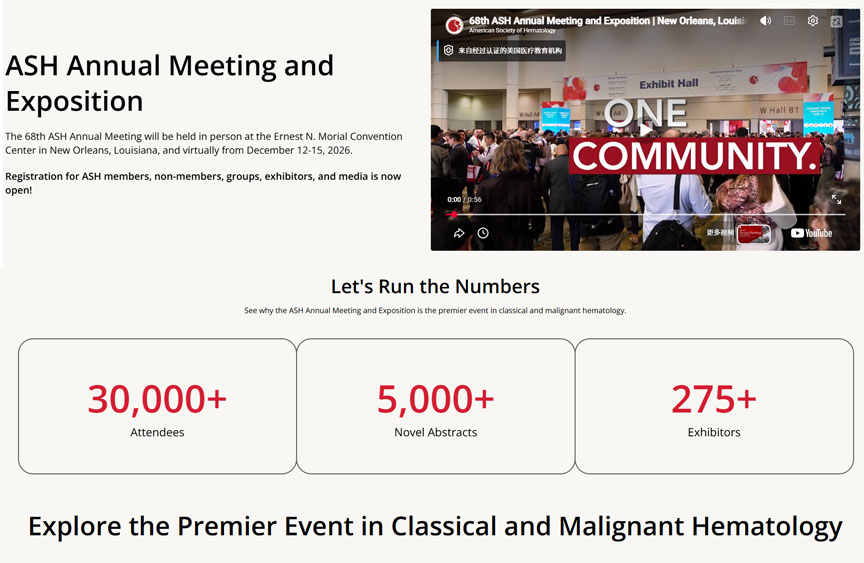

The 68th ASH Annual Meeting and Exposition (ASH 2026) runs December 12–15, 2026, at the Ernest N. Morial Convention Center in New Orleans, with a virtual option. This article is part of our biomedical conference guides for R&D teams.
If you are already planning to attend ASH 2026 and are choosing sessions on bispecific antibodies, T-cell engagers (TCEs), and chimeric antigen receptor T-cell (CAR-T) therapy relevant to your R&D project, start with the seven candidate sessions below, a worked example of a scheduling conflict, and the session log template. This guide is based on official material checked on November 11, 2026. Schedules may change, so verify the latest details before adding sessions to your personal schedule.
Dates, location, and participation formats are governed by the official annual meeting page: https://www.hematology.org/meetings/annual-meeting
1.0 Define the research question you want ASH to help you address
1.1 Turn your research question into a one-line session filter
A search for “bispecific” or “CAR-T” returns plenty of hits, but a technology label alone will not tell you which room to sit in. Write down the disease and the research context first, then the gap you need to close, then the material you want to carry back. Pick one primary question and hold one secondary question in reserve. That’s what lets you make the call fast when two sessions land in the same slot.
Take a hypothetical myeloma development team. Their primary question: which education topics will help them frame treatment sequencing after CAR-T failure in myeloma? Their secondary question: how do they locate consolidation studies after BCMA CAR-T, and how do they check the design? They want session content and study material they can take back and cite. Below, those two questions map to the T07 education discussion and to the T02/#425 research presentation respectively.
| Disease / research context | Current question | Material you want | Candidate sessions | Why it stays on the list |
| Hypothetical: post-CAR-T myeloma | Primary: sequencing after treatment failure; secondary: consolidation after BCMA CAR-T | Education topics and trial-design detail | T07; T02/#425 | T07 covers sequencing after CAR-T failure; T02/#425 covers the design of consolidation after BCMA CAR-T. |
| Fill in | Fill in | Fill in | Fill in | Fill in |
If you need a method for choosing sessions, preparing questions, and taking notes, see our PEGS Europe 2026 agenda-planning guide, then apply that method to the ASH sessions below.
1.2 Tell new research presentations apart from education sessions and official search tools
One question can call for different kinds of material. If you are locating a specific study, start with the titles, abstract numbers, and research context inside the oral abstract sessions. If you need disease background or a safety discussion, the scheduled topics in the Education Program are the better first stop. Session type alone does not determine evidence quality, and educational discussions may also draw on research evidence.
| Entry point | What it is good for | What to check before you bookmark it |
| Oral Abstract Session | Pin down a specific study by title and abstract number | Population and research context, the time slot for the individual talk, and where the abstract ends and added data begins |
| Education Program | Disease background, safety, and downstream research questions | Check whether the scheduled topics address your question; distinguish educational overviews from individual trial findings. |
| Education Spotlight | Focused topics and case-based discussion | Disease scope, discussion format, and how participation works |
| Official program search, app, and Navigator | Find sessions, save your plan, re-check changes | Navigator is for registered attendees; confirm login access and current features before you rely on it |
Posters can also help you locate specific studies; this guide focuses on the sessions below rather than selecting posters. Search the official program by disease and technology keyword: https://onlineprogram.hematology.org/ . Notes on the app, the virtual platform, and the other meeting tools are posted here: https://www.hematology.org/meetings/annual-meeting/meeting-and-presenter-resources/meeting-resources
2.0 Shortlist ASH 2026 bispecific and CAR-T sessions by research question
The table below pulls seven sessions that can be located on this year’s official program. Between them they cover study population and treatment setting, combinations and sequencing, early-phase CAR-T work, longer-term safety, and disease background. The list leans toward myeloma, with B-cell acute lymphoblastic leukemia (B-ALL) and diffuse large B-cell lymphoma (DLBCL) added on; everything falls between December 12 and 14. It’s not a sweep of every indication, of basic mechanism, or of the December 15 program, and the order implies nothing about scientific importance or efficacy.
How to read the table: T01–T07 are editorial labels for this article, not official ASH numbers. Times are local Central Standard Time in New Orleans (CST, UTC−6) and cover the whole session block. For the start time of an individual presentation, check the latest official program.
| ID and question | Session | Local date and session time | Room |
| T01: regimens across trial phases | 654. Multiple Myeloma: Pharmacologic Therapies; trispecific antibody abstract #110 | Dec 12, 9:30–11:00 a.m. | La Nouvelle A-B |
| T02: TCE regimens, combinations, sequencing | 654. Multiple Myeloma: Pharmacologic Therapies: The March of Immunotherapy; #421, 424, 425, 426 | Dec 12, 4:00–5:30 p.m. | La Nouvelle C |
| T03: early-phase CAR-T studies | 704. Cellular Immunotherapies: Early Phase Clinical Trials and Toxicities; B-ALL abstract #559 | Dec 13, 9:30–11:00 a.m. | 343–345 |
| T04: longer-term CAR-T safety | Education Program: Driving CARs Safely | Dec 13, 4:30–5:45 p.m. | New Orleans Theatre C |
| T05: DLBCL disease background | Education Program: Diffuse Large B-cell Lymphoma | Dec 14, 2:45–4:00 p.m. | 278–282 |
| T06: cross-indication framing | Education Spotlight: Bispecific Antibody Therapy vs CAR T Therapy in Lymphoid Malignancies | Dec 14, 4:30–5:45 p.m. | 271–273 |
| T07: downstream myeloma questions | Education Program: Multiple Myeloma: The Future is Now | Dec 14, 4:30–5:45 p.m. | Hall E |
T01 and T02 both sit under official classification number 654, but they are separate sessions; match on full title, date, and time block when you search. Several abstracts in T02 belong to the same session, so don’t read them as a scheduling conflict. For the exact slot an individual talk runs in, check the latest official program.
T01 session and abstract #110: https://onlineprogram.hematology.org/session-details.aspx?sid=118898
T02 session and the related abstract numbers: https://onlineprogram.hematology.org/session-details.aspx?sid=118976
T03 session and abstract #559: https://onlineprogram.hematology.org/session-details.aspx?sid=118911
T04, the education session on longer-term CAR-T toxicity: https://ash-journalforward.azurewebsites.net/am26/EducationProgram.html#117953
T05, the DLBCL education session: https://ash-journalforward.azurewebsites.net/am26/EducationProgram.html#117955
T06, the bispecific versus CAR-T Education Spotlight: https://ash-journalforward.azurewebsites.net/am26/EducationSpotlight.html#117957
T07, the myeloma education session: https://ash-journalforward.azurewebsites.net/am26/EducationProgram.html#117958
If an anchor link doesn’t jump to the right spot, search the full English session title on the Education Program index page for T04, T05, and T07: https://ash-journalforward.azurewebsites.net/am26/EducationProgram.html . For T06, search the Education Spotlight index page: https://ash-journalforward.azurewebsites.net/am26/EducationSpotlight.html .
2.1 How bispecific and TCE teams should chase new-regimen, combination, and sequencing questions
Separate population, prior therapy, trial phase, regimen, and comparator before you decide which document to open. Abstract #110 covers newly diagnosed myeloma; #421 covers relapsed or refractory myeloma. Both involve trispecific antibodies, but the populations differ, and trispecifics should not be lumped in with bispecifics as a class. #424 compares elranatamab monotherapy against daratumumab, pomalidomide, and dexamethasone (DPd); #426 covers a combination regimen and its comparator. What you verify is each study’s enrolled population, prior lines, phase, and actual comparator, not a cross-trial ranking.
Say the team keeps T02/#425 for the secondary question. That abstract deals with consolidation after BCMA CAR-T. Next step is the source material: enrolled population, prior therapy, trial phase, regimen. A title alone does not make #425 evidence for salvage after CAR-T failure; the primary question is covered instead by the scheduled T07 education topics. T01/#110 enrolls a newly diagnosed population, which does not match this question, so it drops down the list. If your question focuses on molecular engineering, also look for dedicated engineering material.
If you still need to connect bispecific design, translational assessment, and dose selection into one learning path, our AET US 2026 training and workshop guide is a reasonable place to start. Then sharpen the questions you want ASH data to answer.
2.2 How CAR-T teams can split research presentations from safety learning
Start with #559 in T03 when you want to check a specific study’s context. The title covers a refractory pediatric and young adult B-ALL population that has failed prior CD19 CAR-T therapy, and a study giving CD22 CAR-T together with a humanized CD19 CAR-T. Verify subject population, trial phase, and design in the source material, and do not extrapolate that setting to myeloma.
If the job is to build a longer-term safety question list, T04 is the education entry point. Bring two questions with you. How does the session frame long-term follow-up for prolonged cytopenias and secondary malignancies? Which parts provide an educational overview, and which send you back to the primary studies the speakers cite? Choose T03 or T04 depending on what the work requires; you don’t have to sit through both, and an education discussion should not be pooled with trial data into a risk statistic.
2.3 Sort candidates into keep, backup, and drop
Check each candidate against your primary question: do the disease and research context match, does the material type serve the question in front of you, and does it duplicate something already on the list? T05 supplies the DLBCL background, T06 discusses bispecifics and CAR-T across lymphoid disease settings, T07 stays closest to myeloma. The table below is one hypothetical team’s output, not a universal must-attend list.
| Candidate | Hypothetical team’s call | Reason or open item |
| T01 | Not a priority | #110 enrolls newly diagnosed patients, which does not match the primary question here |
| T02 | Keep, for the secondary research question | #425 covers consolidation after BCMA CAR-T; verify the design |
| T03 | Drop | B-ALL does not match the myeloma primary question |
| T04 | Backup | Hold in reserve if longer-term safety questions come up; does not replace a research entry point |
| T05 | Drop | DLBCL background is not the priority here |
| T06 | Backup education session | Broadens the cross-indication view; the time conflict with T07 gets resolved in the next step |
| T07 | Keep as the priority education session | Scheduled topics include sequencing after CAR-T failure in myeloma, which matches the primary question |
The “vs” in the T06 title describes how the session is organized. It doesn’t establish that a head-to-head trial exists, and it’s not grounds for making a treatment decision in a patient.
3.0 When sessions run in parallel, choose according to your research objective
3.1 Choose a priority session when two sessions fully overlap on December 14
T06 and T07 both sit on December 14, 4:30–5:45 p.m., overlapping for the full 75 minutes, in 271–273 and Hall E respectively. Both concern immunotherapy, but their scheduled topics address different research questions.
| Hypothetical primary question | Preferred session | How to handle the other session | Still to verify |
| Need a cross-indication view of bispecifics versus CAR-T, including sequencing | T06, 271–273 | List T07 as a backup or consider on-demand review, subject to confirmed coverage and access. | Specific topics, participation format, per-session on-demand coverage |
| Primary question is sequencing after CAR-T failure in myeloma | T07, Hall E; scheduled topics address it directly | List T06 as the cross-indication backup | Topic updates, participation format, per-session on-demand coverage |
The team selects T07 as its priority education session because the scheduled topics already name sequencing after CAR-T failure, and keeps T06 for cross-indication breadth. If T06 is unavailable to you on demand, save the open questions and the session’s official page, then search public education material or the speakers’ published work against those questions. If the gap will not close, log it. Do not treat other material as a stand-in for the recording. Individual talk times and actual transfer times between rooms have not been verified here. Do not assume that switching rooms mid-session will allow you to hear both sessions in full.
3.2 Put live attendance and pending on-demand review on the same plan
Set content priority first, then choose in-person, livestream, or pending on-demand based on your own needs and access rights. ASH states that most in-person sessions are livestreamed on the virtual platform and that recordings are generally available on demand after sessions end, with some exceptions. Your access period depends on the registration option you choose. Virtual platform on-demand and the separately sold Annual Meeting Webcasts are different products. Check what each one entitles you to before you buy or use it.
| Session and hypothetical question | Priority or backup, time slot, and conflicts | Live participation and review / access | Next step |
| T02/#425: consolidation after BCMA CAR-T | Secondary research session; Dec 12, 4:00–5:30 p.m., La Nouvelle C; no overlap with T06/T07 | Full block verified; talk slot, your participation mode, and review conditions still open | Check the latest per-talk schedule and the source material, then add it once your other commitments are clear |
| T07: sequencing discussion after CAR-T failure | Priority education session; Dec 14, 4:30–5:45 p.m., Hall E | Content is a priority; the team plans to attend live. If switching to on-demand, confirm coverage and your access window. | Re-check title, time, room, and access before you travel |
| T06: cross-indication breadth | Backup; same block, 271–273 | Announced coverage, your access window, and whether the recording actually posts are all unverified | Check access and published coverage once the platform opens; look for the recording after the session and log the date you checked if it is not up |
If you have also picked up T05 on DLBCL, there are 30 minutes on the grid between its end and the start of T06/T07. That’s a gap in the schedule, not proof of the time it takes to change rooms. Leave margin based on your own situation and the latest agenda.
General guidance on livestream and on-demand access: https://www.hematology.org/meetings/annual-meeting/meeting-and-presenter-resources/meeting-resources
Access windows and product details by registration tier: https://www.hematology.org/meetings/annual-meeting/registration-information
4.0 Run the pre-meeting checks and leave a record you can audit
4.1 Re-check the key fields when new material drops, and again before you travel
Regular abstracts are already public. ASH plans to release late-breaking abstracts (LBAs) on December 7 at 9:00 a.m. Eastern, which is 22:00 the same day in Shanghai. The virtual platform is scheduled to open December 9; take the exact hour from the official platform notice. These are windows for refreshing your material, not deadlines by which you have to finish your scheduling.
| Trigger | What to check | When to update the plan |
| When first screening sessions, or before adding them to your calendar | Session title, date, full block, room, participation format | If a change affects your primary question or creates a conflict, review your priority and backup choices. |
| After LBAs post on December 7 | Whether anything new bears on the primary question | Update the shortlist only if something relevant lands; do not assume a relevant abstract will appear |
| After the platform opens on December 9 | Login access, your access window, published per-session coverage | Keep anything unclear flagged as unverified |
| After the relevant session ends | Whether the recording is up, and whether you can access it | If the recording is not yet available, log the date checked and follow the official guidance for checking again. If you cannot access a recording, record the gap. |
| Before travel, and whenever the program changes | Latest session, room, time, and participation mode | Adjust when a conflict or a room change appears |
Abstract release and the embargo on new data added at the presentation are two different things. ASH has its own rules for analyses, slides, and other content added beyond the abstract in an oral presentation, and public availability is not permission to reproduce or republish abstract text, figures, or slides. Before you prepare anything for external distribution, check the presentation restrictions and embargo policy, and the copyright rules, separately.
Release timing for regular abstracts, LBAs, and content added at the presentation: https://www.hematology.org/news-and-media/annual-meeting-press/embargo-policy
Copyright and reuse rules for abstracts and related content: https://www.hematology.org/meetings/annual-meeting/abstracts/copyright-and-reuse-policy
4.2 Use a one-page log to run the team discussion and the follow-up checks
When you hear a claim you want to investigate, record its source and the primary material to check, then add your interpretation separately. The example below contains only pre-meeting plans and verified scheduling information. Copy the fields for your own notes.
| Field | How to fill it in | Hypothetical team’s pre-meeting entry |
| My research question | Write the primary and the secondary question separately | Primary: sequencing after CAR-T failure in myeloma; secondary: design of consolidation after BCMA CAR-T |
| Session / abstract number | Record the session title and official abstract number | T02/#425; priority education session T07, with T06 as backup |
| Source and access date | Save the original URL and the date you checked | T02: https://onlineprogram.hematology.org/session-details.aspx?sid=118976 ; T07: https://ash-journalforward.azurewebsites.net/am26/EducationProgram.html#117958 ; accessed November 11, 2026, refresh before use |
| Verified facts | Record only verified scheduling and session-identification details | T07 is December 14, 4:30–5:45 p.m., Hall E; fully overlaps T06 |
| Open questions / claims, and the material needed | Write questions before the meeting; if you log a speaker’s claim afterward, tag the source and its verification status | Check enrolled population, prior therapy, trial phase, and regimen design in the source material for #425 |
| My interpretation | Keep your interpretation separate from what the speaker or ASH said | T07 matches the primary question; T02/#425 is retained for follow-up on the supplementary study-design question. |
| Next action | State what to check, who is responsible, and the planned date | Check platform access and published coverage after December 9; look for the actual recording after T06; re-check time and room before travel; owner and date to be filled in by the team |
If a claim you heard in the room is still unverified, mark it as open and keep the URL that gets you back to the source.