
AI-generated scene of researchers reviewing conference notes.
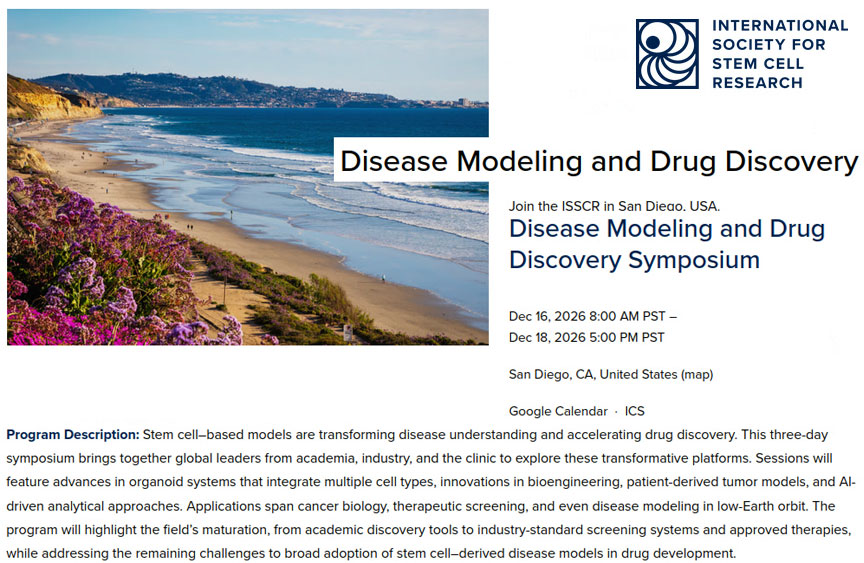
Suppose your team has used a model for exploratory screening and wants to know whether the evidence can inform its next discussion about translational research. Use this ISSCR 2026 San Diego session guide to find the December 17 preclinical model evaluation roundtable and choose one more session that addresses the gap most likely to affect your decision. Copy the table below into your notes to track what you can verify and what still needs checking. The International Society for Stem Cell Research (ISSCR) will hold its 2026 Disease Modeling and Drug Discovery Symposium from December 16 to 18 at the Hilton San Diego Bayfront in San Diego, California. The agenda was checked on November 23, 2026. All times are in Pacific Standard Time (PST, UTC−8).
Confirm the meeting dates, venue, and official agenda: https://www.isscr.org/upcoming-events/2026-san-diego-international-symposium
1.0 Define the R&D Decision Before Choosing Sessions
Start by marking the December 17 roundtable on your agenda. Before choosing a second session, identify what your team most needs to clarify: what the model was compared with for the same intended use, which research questions the model can address, or how reproducible the results are.
1.1 Start With the December 17 Model Evaluation Roundtable
The December 17 roundtable, “Evaluating Preclinical Models Across the Drug Development Pipeline,” is scheduled from 11:10 to 12:20 in Indigo AE at the Hilton San Diego Bayfront. The agenda lists Shuibing Chen as chair, with panelists from IRB Barcelona, Roche, and a:head bio. As you listen, identify which decision in the drug development process each panelist is addressing.
If you are deciding whether a screening signal warrants a closer look, ask yourself two questions. “What did the speaker compare the model with? How does that comparison inform the decision our team needs to make?” Write the questions next to the session on your agenda.
Confirm the roundtable title, time, and speakers: https://isscr-is26sandiego.secure-platform.com/sandiego/solicitations/102011/sessiongallery/schedule/items/94335
1.2 Choose One More Session That Addresses the Same Question
All four options below are scheduled in Indigo AE. Choose one. If you will already be in San Diego on December 16, that day’s session can come before the roundtable.
- If you want to know whether a model’s context of use matches your research question, consider “Complex In Vitro Human Models” on December 17, 13:25–15:15. The agenda lists a talk on organs-on-chip models of human pathophysiology. If it is relevant to your project, ask “Would the context of use the speaker describes help us answer our research question?” If your project focuses on breast cancer, the SABCS 2026 guide to model-platform questions has examples of what to ask about organoid heterogeneity, microenvironment coverage, and chip readouts.
See the agenda for Complex In Vitro Human Models: https://isscr-is26sandiego.secure-platform.com/sandiego/solicitations/102011/sessiongallery/schedule/items/94336
- If you want to know what a useful comparison should include, consider “ISSCR Consortium: Advancing NAMs” on December 18, 09:00–10:40. NAMs stands for new approach methodologies. Developing standards and bringing evidence from different sources together are priorities for the consortium. Listen for the comparisons the speakers describe and whether they apply to your team’s intended use.
See the NAMs session and its Q&A: https://isscr-is26sandiego.secure-platform.com/sandiego/solicitations/102011/sessiongallery/schedule/items/94338
Read about the consortium’s work on standards and evidence integration: https://www.isscr.org/disease-modeling-drug-discovery
- If you want to know whether results remain comparable when a model is used at a larger scale, consider “Scalable Disease Modeling and Translation” on December 18, 14:45–16:15. Check how each item is labeled. If one is listed as an Innovation Showcase, treat it as a lead and look for publicly available material that supports a comparison.
See the presentations and Innovation Showcase in Scalable Disease Modeling and Translation: https://isscr-is26sandiego.secure-platform.com/sandiego/solicitations/102011/sessiongallery/schedule/items/94341
- If you will already be in San Diego on December 16 and want to understand how exploratory and regulatory uses differ, consider “Drug Discovery and Therapeutic Development II” from 14:55 to 16:20. The agenda lists a talk on qualifying 3D human microphysiological systems for drug discovery and regulatory use. Use the title to frame a question about the specific context of use the speaker will discuss.
See the talk titles in Drug Discovery and Therapeutic Development II: https://isscr-is26sandiego.secure-platform.com/sandiego/solicitations/102011/sessiongallery/schedule/items/94333
Before you travel, check the official schedule again to confirm the time and room for each of your two sessions.
Check the full official schedule for times and rooms: https://isscr-is26sandiego.secure-platform.com/sandiego/solicitations/102011/sessiongallery/schedule
2.0 Use One Table for Both Sessions
2.1 Start With the Intended Use and the Evidence to Check
Copy the table into your notes. In both rows, record the same intended use and the decision your team needs to make. In the third column, note what the model was compared with if the public material identifies a comparator, and cite the source. If you have only the agenda, identify it as such in the third column and mark the assessment “To be verified.” In the last column, write your own follow-up questions and where you can look for answers.
| Session | Intended use to check | Basis for comparison and source | Assessment so far | Follow-up questions and checks |
| December 17 model evaluation roundtable | Exploratory screening. Can the evidence inform the next translational research discussion? | Official roundtable agenda checked. Basis for comparison still to be verified. | To be verified | Look for public material that identifies what the model was compared with and what the comparison covers. |
| December 18 NAMs session (example second session) | Exploratory screening. Can the evidence inform the next translational research discussion? | Official session agenda checked. Basis for comparison still to be verified. | To be verified | Check whether public material from the speakers addresses the same intended use and identifies a comparable benchmark. |
ISSCR prohibits recording sessions, presentations, and posters by photo, screen capture, audio, or video, as well as copying or downloading scientific results from them. Abstract content is embargoed until the corresponding presentation begins. During each session, note your own follow-up questions and any sources you can verify publicly.
Check ISSCR’s rules on recording and abstract embargo: https://www.isscr.org/code-of-conduct
2.2 A Pre-Meeting Example
The example uses the published agenda and a hypothetical research question. At the roundtable, identify the decision each speaker is addressing. At the NAMs session, look for evidence that supports a comparison for the same intended use. If that session turns out to discuss evidence for a regulatory submission focused on safety, mark it “Reference only.” Your team is deciding whether a screening signal is worth pursuing. If you choose a different second session, keep the research question and update the session details and where you will look for evidence in the second row.
3.0 Hand the Record to a Colleague for Review
3.1 Check Whether Both Sessions Address the Same Intended Use
Review both rows. Identify the intended use each speaker discussed, then check what the public materials identify as the comparator. Mark “Comparable” only if the intended uses match and the materials identify comparators similar enough to support a comparison. If the intended uses differ, mark “Reference only.” If the public material is too limited to assess comparability, mark “To be verified.” Keep your own follow-up questions in the last column. In column three, record the material a colleague can verify publicly, along with the publisher, link, and date accessed. If your team is unsure whether the gap is in the model assumptions or the measurements used to interpret the results, see the AAPS PharmSci 360 2026 track guide for examples of how to separate translational modeling questions from bioanalytical questions.
The National Institutes of Health (NIH) article on model selection recommends choosing a model that fits the research question and considering its context of use. Use those points to check how closely the materials you found match your team’s question.
Read NIH’s article on selecting models for a research question: https://grants.nih.gov/news-events/nih-extramural-nexus-news/2026/05/selecting-the-right-models-for-your-research-a-focus-on-new-approach-methodologies-nams
The submission instructions state that abstracts presented at the meeting will be included in a PDF abstract book. As of November 23, 2026, we could not verify when the book would be released or who could access it. If you find publicly available materials after the meeting, add the relevant links and dates accessed.
See the symposium’s information on abstract submissions and the abstract book: https://isscr-is26sandiego.secure-platform.com/sandiego
3.2 Hand Off the Next Step in Three Sentences
Summarize the handoff in three sentences and put them in the table’s last two columns. If you still have only the agenda as you prepare for the first team debrief, use this example.
- We have checked the posted schedules for the roundtable and NAMs session, and the model evidence still needs verification.
- We still need a publicly available, verifiable comparison for the same intended use.
- Before the first team debrief, ask the colleague leading model evaluation to use the official agenda to find public materials from the speakers and log the links and dates accessed for anything that matches the session.