SABCS 2026 Research Sessions: An Investigator’s Guide
Facts checked November 16, 2026. All session times are local San Antonio time (CST, UTC−6); Beijing time runs 14 hours ahead.

AI-generated conference-planning scene; not a photograph of SABCS 2026.
At midday on December 8, the SABCS 2026 models workshop and the AI pathology workshop run head to head. In the December 9 spatial session, several titles all mention treatment response, yet the study populations behind them split between early-stage and advanced triple-negative breast cancer (TNBC). Deciding which room to sit in, and which abstract to chase, starts with putting your own research question on the table.
The San Antonio Breast Cancer Symposium runs December 8–11 in San Antonio. For preclinical and translational investigators working on questions involving models, the tumor microenvironment (TME), or spatial data, this guide organizes selected SABCS 2026 research sessions by project need, helping you prioritize relevant sessions and prepare specific questions for follow-up. Screening at this stage rests on the published agenda and abstract titles alone, and says nothing about study quality or outcome.
Meeting dates, venue, and official overview: https://www.sabcsmeetingnews.org/registration-now-open-for-sabcs-2026/
1.0 Rank Sessions by Project Question First
Start with one sentence: what kind of information is this project missing most right now? Do you need to understand how patient-derived models preserve heterogeneity, clarify the biological context of metastasis to a particular organ or of a specific immune-cell population, or find spatial studies involving samples comparable to yours? A single project may involve several of these questions. Start with the information gap that matters most to your current decision.
| Project question | Priority sessions and add‑ons | Known clues, material still to add | Question to bring |
| Understanding heterogeneity and drug response in patient-derived models | Start with the models workshop (WS1); add the organ-specific metastases and systemic immunity session (ED4) when organ-level metastasis is in scope. Projects built on pathology images should also weigh the AI pathology workshop (WS2). | WS1 covers organoids, microfluidics, and lab-on-chip platforms; check the applications and limitations discussed in each presentation. | Which sources of heterogeneity does the model retain, and which ones matter to my question but stay uncovered? |
| Nailing down organ or immune-cell context | For organ questions, take the organ-specific metastases and systemic immunity session (ED4); for B cells, NK cells, or non-macrophage myeloid populations, take the TME cell session (ED11). | ED4 is organized by organ and metastatic setting; ED11 by cell type, so individual talks still need matching. | What cell definition or organ context does the talk use, and where does it diverge from my project? |
| Finding spatial work in a comparable setting | Spatial and immune Poster Spotlight (PS1): PS1-3: early TNBC, neoadjuvant chemotherapy plus immunotherapy; PS1-5: advanced TNBC, intratumoral IL-12; PS1-7: early TNBC, B-cell spatial questions under neoadjuvant therapy. | Titles already give partial population and data clues; sampling timepoints, assay content, and validation come after abstracts open. | Which spatial relationships did the study analyze, and how close are the samples and treatment setting to my project? |
Priority in the table reflects how well public topics match project needs. Items set in a different research context can be kept as a methods reference or dropped for now.
Copy the most relevant row into your own notes, restate the project question in your words, and record the sessions you actually choose. Workshops can help you explore methods and take part in interactive activities; educational sessions provide background on a topic; Poster Spotlights let you examine a specific study in more detail. Official titles and lookup links for each session appear at the end of the relevant subsection.
2.0 Models and Microenvironment: First Decide Which Layer You Are Missing
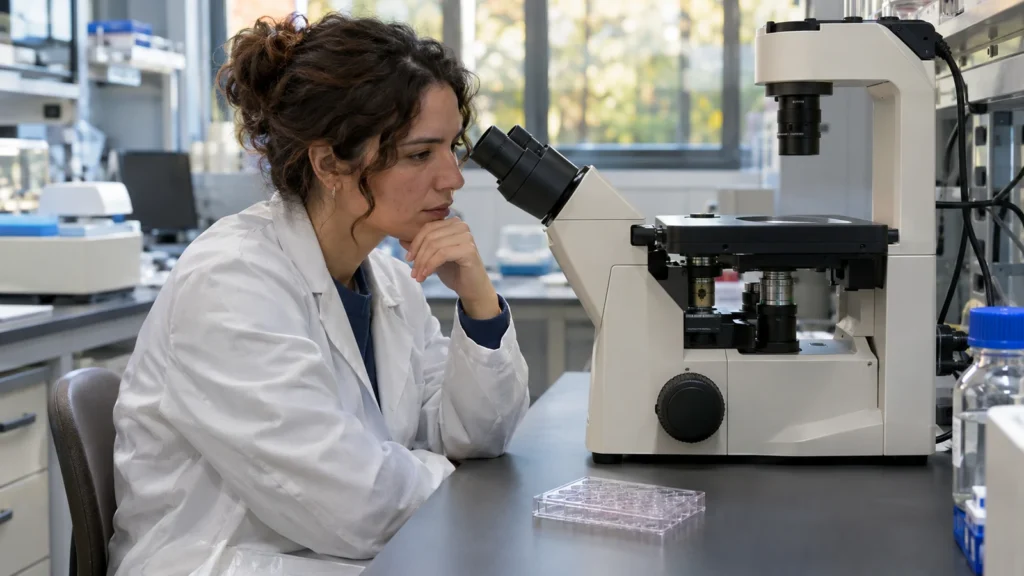
AI-generated laboratory scene for a discussion of research-model choices.
2.1 For Model-Platform Questions, Start With the Three WS1 Topics
The models workshop (WS1) is scheduled for December 8, 12:45–14:15, in Stars at Night 1-2. The published agenda lists three items, each supporting a different line of questioning:
• WS1-01: Patient-derived organoids, tumor heterogeneity, and drug response. If the project rests on patient-derived models, ask first how the talk defines and assesses heterogeneity, then whether what it preserves and what it omits affects your own question.
• WS1-02: Microfluidics and microenvironment modeling. If you need to judge whether a model accounts for the microenvironmental components your project cares about, ask: “Which cells or environmental factors does the model include, and which are still missing?” Keep the focus on biological composition and coverage.
• WS1-03: Lab-on-chip platforms. If your experimental question is already clear and you are weighing whether a chip can deliver the measurement you need, ask: “What readouts does this platform give, and which of my project’s questions does each one answer?” Keep the focus on how platform output maps onto the research question.
The three topics overlap. Projects centered on drug response should anchor on WS1-01 first, then pick up the microenvironment-composition or platform-readout question wherever the gap sits. These are questions to prepare before you walk in; what the workshop actually runs through still has to come from the organizers or the speakers.
Verify WS1 presentation numbers, speakers, session time, and room (Workshop 1: Beyond Animal Models: Novel Alternative Methods for Breast Cancer Research): https://sabcs.org/events/2026/workshop-1-beyond-animal-models-novel-alternative-methods-for-breast-cancer-research/
2.2 Organ Context Points to ED4; Cell Type Points to ED11
Work on the liver metastatic niche or on specific immune populations can also start from the educational sessions. Either ED4 or ED11 works as the primary pick; add the models workshop only when a platform question is in play.
ED4 runs December 8, 14:30–16:15, in Hemisfair 3, with three topics covering lymph node metastasis and systemic immunity, the liver microenvironment, and models of organ tropism. Liver-metastasis projects should anchor on ED4-02; questions about organ-tropism models start with ED4-03.
ED11 runs December 9, 14:30–16:15, in 221 ABC, moving through B cells, NK cells, and myeloid populations beyond macrophages. B-cell projects should prioritize ED11-01; NK-cell projects anchor on ED11-02. When nothing in the session matches your question, there is no reason to put the whole block on your must-attend list.
If your work concerns B-cell spatial positioning in early-stage TNBC, pair PS1-7 with ED11-01: take in the specific study at the morning PS1 session, write down what puzzles you, then bring those questions to the afternoon B-cell talk.
Optional addition | When macrophages are the project’s focus, also look at SA3-02. The translational methods session that houses it, SA3, runs December 10, 16:30–18:15, in Hemisfair 1-2; it recaps content from the AACR annual meeting and also covers risk models and copy-number topics. Only the session-level time is verified so far, and individual talk start and end times still need confirmation.
Review ED4 report topics and scheduling (Educational Session 4: Interplay Between Organ-Specific Metastases and Systemic Immunity): https://sabcs.org/events/2026/educational-session-4-interplay-between-organ-specific-metastases-and-systemic-immunity/
Review ED11 cell topics and agenda (Educational Session 11: The Forgotten Cells of the TME): https://sabcs.org/events/2026/educational-session-11the-forgotten-cells-of-the-tme/
Review SA3 report topics and session time (State of the Art 3: Innovative Translational Methods: Highlights From the AACR Annual Meeting): https://sabcs.org/events/2026/state-of-the-art-3-innovative-translational-methods-highlights-from-the-aacr-annual-meeting/
3.0 Spatial Studies: Match the Research Context Before the Technology Name
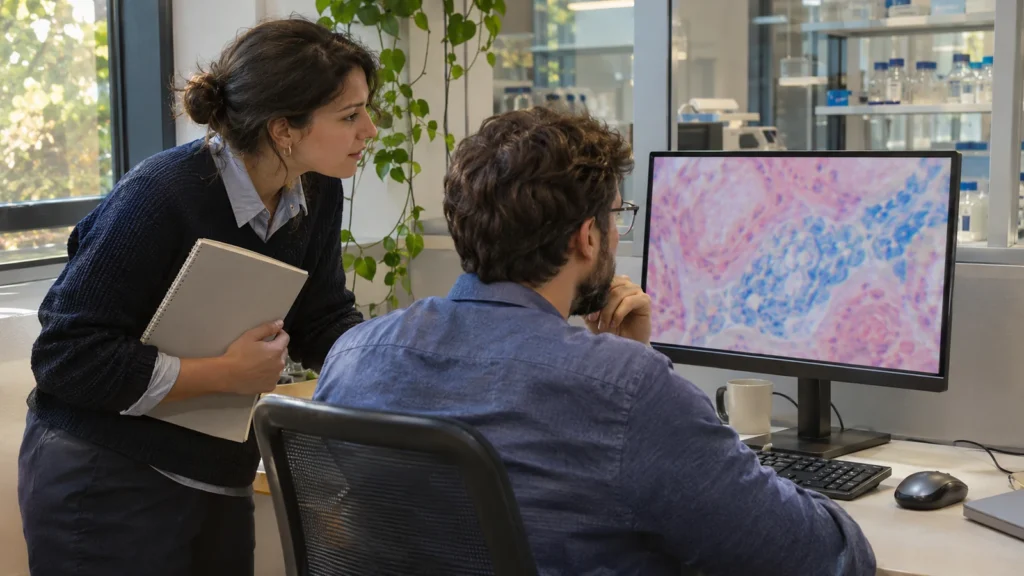
AI-generated research-discussion scene; the screen does not show study data.
3.1 PS1-3, PS1-5, and PS1-7 Sit in Three Different Contexts
PS1 is scheduled for December 9, 07:00–08:30, in Hemisfair 3. All three items below involve spatial work, yet each is best entered from a different question.
PS1-3 addresses early-stage TNBC treated with neoadjuvant chemotherapy plus immunotherapy, and the title indicates proteomic and spatial transcriptomic data are combined. If you care how those two data types work together in analyzing treatment response, dig next into sampling timing, the response endpoint, and how findings were validated.
PS1-5 covers advanced TNBC under intratumoral IL-12, with the title centering on spatial multi-omics in clinical responders. Stage and treatment setting both differ from PS1-3. Worth chasing here: whether non-responders were analyzed, and whether a pre- and post-treatment comparison exists. The title emphasizes responders, which is no grounds for concluding that the full abstract makes no other comparisons.
PS1-7 focuses on extrafollicular DN2/3 B-cell spatial niches in early-stage TNBC under neoadjuvant therapy. If your question centers on B-cell state and spatial position, PS1-7 is the most directly relevant of the three. Which assay platform was used, and which neoadjuvant regimen is involved, still have to be confirmed in the abstract.
Initial screening across these three rests on research context. Even though all three discuss treatment response, titles alone do not support comparing efficacy or predictive performance.
Look up PS1 item numbers, full titles, and scheduling (Poster Spotlight 1: Spatial and Immune Drivers of Therapeutic Response in Breast Cancer): https://sabcs.org/events/2026/poster-spotlight-1-spatial-and-immune-drivers-of-therapeutic-response-in-breast-cancer/
3.2 A B-Cell Project Example: What to Keep, Deprioritize, and Check Next
Hypothetical example | You already hold early-stage TNBC samples from neoadjuvant treatment, and B-cell state and spatial position are what matter most right now. Against that specific task, initial screening might land in your notes like this:
Keep PS1-7 as the priority. List PS1-3 as a candidate: once abstracts open, check whether its analyses help answer questions about B-cell state or spatial position, then verify the regimen, sampling timepoints, and data types. PS1-5 sits too far from this context, so downgrade it to a methods reference; if this round is strictly about comparable settings, leave it off.
Add ED11-01 if you need B-cell background. With no macrophage or new-model-platform question on the table, SA3-02 and WS1 stay off the priority list. That trade-off applies only to the example above and says nothing about the value of these sessions to other projects.
Once abstracts are available, check the three details most likely to change your selection: how DN2/3 cell state and the spatial neighborhood are defined; whether sampling timepoints and treatment setting are close to your own project; and what analyses and validation support the response-related interpretation.
If the material supports association only, log it as a correlative lead. If samples or treatment setting diverge substantially, reclassify it as a methods reference. Details the abstract does not address get marked “to ask”; absence of reporting is not evidence that the work was never done.
If the definition of the spatial neighborhood is your biggest gap and the abstract still does not settle it, the question you carry into the room can be exactly this: “How do you define the spatial neighborhood around DN2/3 B cells?” Close that specific gap first, then decide which methodological details are worth chasing.
4.0 Turn the Shortlist Into Pre-Meeting Prep
4.1 WS1 and WS2 Run in Parallel: Choose by Primary Task, Then Confirm the Reservation
On December 8, 12:45–14:15, WS1 meets in Stars at Night 1-2 and the AI pathology workshop (WS2) in Stars at Night 3-4. The two overlap end to end: questions centered on model platforms belong with WS1; questions centered on pathology images, subtype prediction, or biomarker analysis applications belong with WS2. When both are relevant, pick by whichever task the project most needs solved now. When neither fits, skipping both is a legitimate call.
The official workshop notice is explicit that both require advance registration and carry a modest fee. What we reviewed states the reservation and fee requirements only; as of November 16, the exact amount, remaining seats, registration deadline, and actual booking status remain unverified and have to be confirmed through the official registration flow. Until a reservation is secured, mark the workshop as tentative. If you cannot get in, the selected topic sessions or published materials are the fallback, though the content and the chance to interact are not equivalent.
As of November 16, only session-level times are verified; individual talk times still need confirmation, so do not plan to split a half-session across rooms on that basis. Official registration information describes live streaming and on-demand access in general terms, but it does not confirm that WS1 and WS2 are each available as a complete recording. Plan as if you can attend only one.
Review WS2 AI pathology topics, time, and room (Workshop 2: Artificial Intelligence-Based Advances in Pathology): https://sabcs.org/events/2026/workshop-2-artificial-intelligence-based-advances-in-pathology/
Review registration, fees, and interaction format for both workshops: https://www.sabcsmeetingnews.org/go-hands-on-with-new-methods-technologies-during-sabcs-2026/
Open the official registration page to confirm available booking options and digital access entitlements: https://sabcs.org/registration-2/
4.2 Update Your Table as Abstracts Become Available and Bring Open Questions to the Meeting
Use your current shortlist as a starting point, and add information at three checkpoints.
① Now: confirm the primary sessions, work through workshop registration, and mark selected items as “provisional, on title only.” Note separately whether the reservation is secured and what information is still missing.
② Once abstracts open: the full text of regular abstracts is slated for release November 23 at 15:30 CT, which is November 24, 05:30 Beijing time. Search by presentation number to find the materials currently available, then revisit the keep, downgrade, or drop decisions and flag anything unresolved as “to ask.” The app is expected November 30; once it is live, recheck session times and room assignments.
③ During the meeting: electronic posters are slated to open December 8 at 11:00 CT, which is December 9, 01:00 Beijing time. Confirm whether the selected items are actually accessible, and note the material date, source link, and the questions still to raise with the authors.
Each time you add material, update the row you copied in section 1.0. Column two holds the actual selection with time and room; for workshops, add reservation status. Column three records the material date, source link, and what has been confirmed versus what is still open. Column four keeps only the single question you most need answered right now.
To turn your shortlist into a day-by-day plan, see the worked example in our ASHG 2026 research itinerary planning guide. Apply the planning method to the current SABCS schedule.
Abstracts tied to the press program follow a separate embargo schedule, and information in oral presentations that goes beyond the abstract is subject to embargo rules until the session starts; the regular abstract release time cannot be applied across the board. Whether specific materials are accessible still has to be confirmed item by item, and being able to read a poster or slide deck is not permission to reproduce it.
Review poster material and author permission guidance: https://sabcs.org/poster-presentation-guidelines/
Review oral presentation material and slide permission guidance: https://sabcs.org/oral-presentation-guidelines/
Confirm abstract and electronic poster release times, plus press program exceptions: https://sabcs.org/media/
Check the app launch and other official key dates: https://sabcs.org/key-dates/
Times and room assignments cited here come from the individual session detail pages and have not been cross-checked against the Planner. Before the meeting, confirm the final schedule in the official Planner: https://cattendee.abstractsonline.com/meeting/21592